

Sponsor content is created on behalf of and in collaboration with Doba by DigitalCommerce360. Our editorial staff is not involved in the creation of the sponsored content.
New research from Doba’s 2026 U.S. Drop Shipping Market Report finds that the traditional cross-border ecommerce playbook — long shipping times, anonymous suppliers and low-cost sourcing — is rapidly collapsing as U.S. consumers demand faster delivery, transparent fulfillment and more reliable shopping experiences.
The old cross-border ecommerce playbook is breaking down.
For years, many online retailers built businesses around a simple formula: source inexpensive products overseas, ship them directly to U.S. customers and compete on price. But a new industry report suggests that strategy is quickly losing ground as consumers demand faster delivery, stronger trust signals and predictable fulfillment.
The findings come from “2026 U.S. Drop Shipping Market Report,” a new white paper from Doba, a technology platform that connects ecommerce merchants with product suppliers and fulfillment partners. Doba provides sourcing tools, supplier marketplaces and inventory integrations that help retailers sell products across online marketplaces and independent ecommerce sites.
According to the report, the forces reshaping consumer expectations, social media-driven product discovery and stricter platform performance standards — are pushing retailers toward a more disciplined operating model built around logistics reliability and data-driven merchandising.
“The playbook is changing quickly,” the 2026 U.S. Drop Shipping Market Report concludes. “Success increasingly depends on removing uncertainty for the customer — in delivery, product quality and the overall buying experience.”
Ecommerce is still growing — but competition is intensifying.
The report arrives as U.S. ecommerce continues expanding but at a slower pace than during the pandemic boom.
Citing industry forecasts, the 2026 U.S. Drop Shipping Market Report notes that U.S. online retail sales are projected to reach approximately $1.9 trillion in 2026, stabilizing with 8% to 9% annual growth. That growth remains significant, but it represents a normalization after ecommerce sales surged more than 30% during the pandemic peak in 2020.
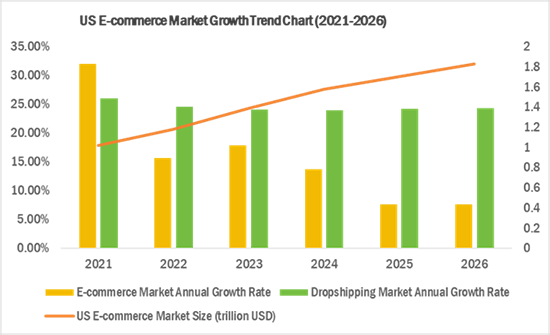
Source: [1] Insider Intelligence, “US E-commerce Forecast 2025: Growth Stabilizes as Market Matures”, Jan 2025. [2] Grand View Research, “Dropshipping Market Size, Share & Trends Analysis Report”, Q3 2024 Update.
As growth stabilizes, retailers increasingly must compete for market share rather than relying on overall market expansion to drive revenue.
Meanwhile, the global drop shipping market continues expanding rapidly, with forecasts cited in the report projecting more than 24% compound annual growth through 2027, when the sector could surpass $38 billion worldwide.
But the report emphasizes that the business model itself is changing. Instead of simply listing low-cost products from overseas suppliers, successful merchants increasingly must practice what the report describes as “product cultivation” — selecting products based on verified demand signals, logistics performance and consumer expectations.
The collapse of “information asymmetry”
For much of the past decade, drop shipping thrived on what the 2026 U.S. Drop Shipping Market Report calls information asymmetry. Retailers knew where to source inexpensive products, while consumers had limited visibility in supplier networks and fulfillment routes.
That advantage has disappeared.
Today’s shoppers routinely compare prices across multiple platforms, verify supplier locations, analyze shipping timelines and examine customer reviews before making a purchase.
According to the report, that transparency has created what it calls a “triple barrier” for modern ecommerce merchants.
The first is a trust gap, as consumers remain skeptical of unfamiliar brands and overseas shipping operations. The second is an experience gap, where slow shipping or complicated return policies discourage repeat purchases. The third is an efficiency gap, created by fragmented supplier networks that can lead to inventory uncertainty and missed delivery expectations.
Crossing those barriers is the central challenge of what the report describes as drop shipping 2.0.
Certainty replaces price as the key buying driver
One of the most significant findings highlighted throughout the 2026 U.S. Drop Shipping Market Report is the rising importance of certainty in online purchasing decisions.
More than 60% of U.S. consumers now prioritize fast and predictable delivery over the lowest price, according to the report. A three-day delivery window has emerged as the psychological expectation for many shoppers, while delivery estimates longer than five days significantly reduce purchase intent.
Return policies are also becoming a growth lever. Retailers offering frictionless return processes report customer lifetime values 25% to 30% higher than competitors with restrictive return policies, the research found.
Buying motivations are shifting as well. The report found that 65% of consumers now prioritize products that solve specific functional problems, such as home organization or workspace efficiency, rather than impulse purchases driven by novelty.
Trust signals increasingly shape those decisions. Indicators such as U.S.-based return addresses, transparent shipment tracking and authentic user-generated video reviews significantly influence purchasing behavior.
Video reviews alone can increase ecommerce conversion rates by as much as 135%, according to the report.
Social video now drives product discovery
Another major trend identified in the 2026 U.S. Drop Shipping Market Report is the role of social media in shaping the shopping journey.
Short-form video platforms such as TikTok and Instagram are increasingly introducing consumers to products through creator content.
The report found that about half of TikTok users conduct cross-platform searches immediately after discovering a product, often verifying product listings on marketplaces or search engines before completing a purchase.
That behavior means retailers must maintain visibility and credibility across multiple digital channels rather than relying on a single platform.
Drop shipping enters a more operationally disciplined era
To compete in this environment, the 2026 U.S. Drop Shipping Market Report argues that retailers must adopt a more structured operating model.
The report outlines three pillars of what it calls drop shipping 2.0.
First, retailers must adopt data-driven product selection, using demand signals and supplier performance metrics rather than trial-and-error sourcing.
Second, retailers must deliver seamless customer experiences, even when fulfillment is outsourced. That includes domestic logistics partners, responsive customer support and high-quality product content.
Third, retailers must build resilient supply chains capable of guaranteeing inventory availability, predictable delivery timelines and centralized coordination across multiple suppliers.
These capabilities are increasingly important on marketplaces such as Amazon and Walmart, where seller rankings and buy-box eligibility depend heavily on delivery reliability and return performance.
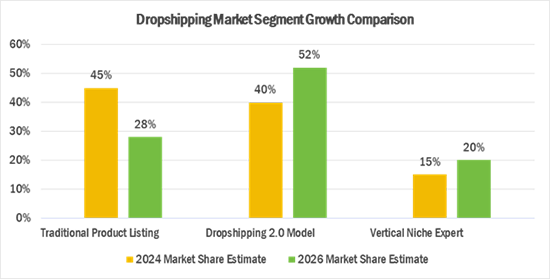
Source: [1]Digital Commerce 360. “How Shipping Influences Buyer Trust and Loyalty.” 2024 Consumer Survey. [2]Jungle Scout. “State of the Amazon Seller 2025.” 2025. [3] McKinsey & Company. “Consumers: Spending more to buy less.” December 2024.
Product strategies shifting toward reliability
The report also identifies several product categories that appear well suited to the new ecommerce environment.
Everyday essentials such as pet supplies, household cleaners and personal-care products offer stable demand and strong repeat-purchase rates.
Bundled products designed to solve specific problems — such as home fitness kits or gardening bundles — are also gaining traction. According to the report, shoppers purchasing bundled solutions typically spend 40% to 60% more per order while returning items less frequently.
Products requiring certifications or compliance credentials, including certain electronics and child-safety products, can also command higher prices because regulatory verification strengthens consumer trust.
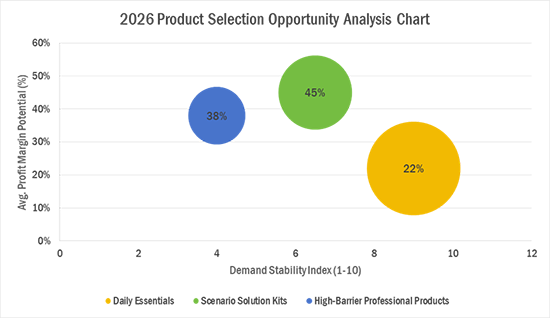
Source: [1]Numerator. “72% OF U.S. HOUSEHOLDS CONCERNED ABOUT RECESSION; MAJORITY OF HOUSEHOLDS ACROSS POLITICAL SPECTRUM BELIEVE TARIFFS WILL HURT THE ECONOMY.” April 2025. [2] Jungle Scout. “State of the Amazon Seller 2025.” 2025. [3] GWI. “Commerce Report: What Shoppers Want.” Q4 2024. [4]Digital Commerce 360. “How Shipping Influences Buyer Trust and Loyalty.” 2024 Consumer Survey.
7 key takeaways from the 2026 U.S. Drop Shipping Market Report
The research identifies several themes that are reshaping how ecommerce retailers must operate:
- Delivery certainty is now a competitive advantage. More than 60% of consumers prioritize fast, predictable delivery over the lowest price.
- A three-day delivery window has become the psychological standard for many U.S. online shoppers.
- Frictionless returns drive loyalty. Retailers offering simplified return processes report 25%–30% higher customer lifetime value.
- Functional products outperform impulse purchases. About 65% of shoppers now prioritize problem-solving products.
- Video reviews significantly boost conversion. Authentic user-generated videos can increase conversion rates by as much as 135%.
- Social video drives discovery. Half of TikTok users search across platforms after encountering a product through creator content.
- Drop shipping is evolving into a data-driven operational system, requiring stronger logistics coordination, verified suppliers and reliable inventory management.
Taken together, the report concludes that drop shipping is no longer a shortcut in ecommerce. Instead, it is becoming a more structured retail operating model built around predictable logistics, transparent supply chains and data-driven product strategies.
Retailers that adapt to those expectations may gain an advantage in an increasingly competitive ecommerce market. Those that continue relying on slow shipping and loosely coordinated supplier networks risk falling behind as consumers demand faster and more reliable online shopping experiences.
Read the Full Report
To access the complete data and operational strategies for 2026, [Download the full 2026 U.S. Drop Shipping Market Report here].
About Doba:
Doba is a leading dropshipping platform, founded in 2002 and headquartered in Salt Lake City, Utah, dedicated to accelerating sustainable business growth for online retailers. By connecting merchants with a comprehensive network of premium suppliers—approximately 90% of whom ship directly from U.S.-based warehouses—Doba delivers the fast, reliable fulfillment required to boost conversion rates and build long-term customer loyalty. Beyond providing an extensive product catalog, the platform empowers sellers with AI-powered automation tools and seamless multi-channel integrations, enabling them to reduce operational overhead, effortlessly scale their business, and maximize revenue. For more information, please visit www.doba.com.
[1] Insider Intelligence, “US E-commerce Forecast 2025: Growth Stabilizes as Market Matures”, Jan 2025.
Presented in collaboration with:
 Favorite
The post Speed, Trust and Certainty Are Rewriting the Rules of Cross-Border Ecommerce appeared first on Digital Commerce 360.
from Digital Commerce 360 https://ift.tt/My08RYi


0 Comments